
The first time you hear a claim, you might question it. The second time, it sounds familiar.
After you’ve encountered it again and again, something subtle can happen: the claim starts to feel true.
Not because you’ve found evidence for it. Not because you’ve carefully fact-checked it. Simply because your brain has seen it before.
This is known as the illusory truth effect- the tendency for repeated information to be judged as more truthful than information encountered for the first time.
And it doesn’t require you to be careless, unintelligent, or particularly gullible. Research suggests that repetition can influence truth judgments even when people have relevant knowledge that should, in principle, help them detect falsehoods.
What Is the Illusory Truth Effect?
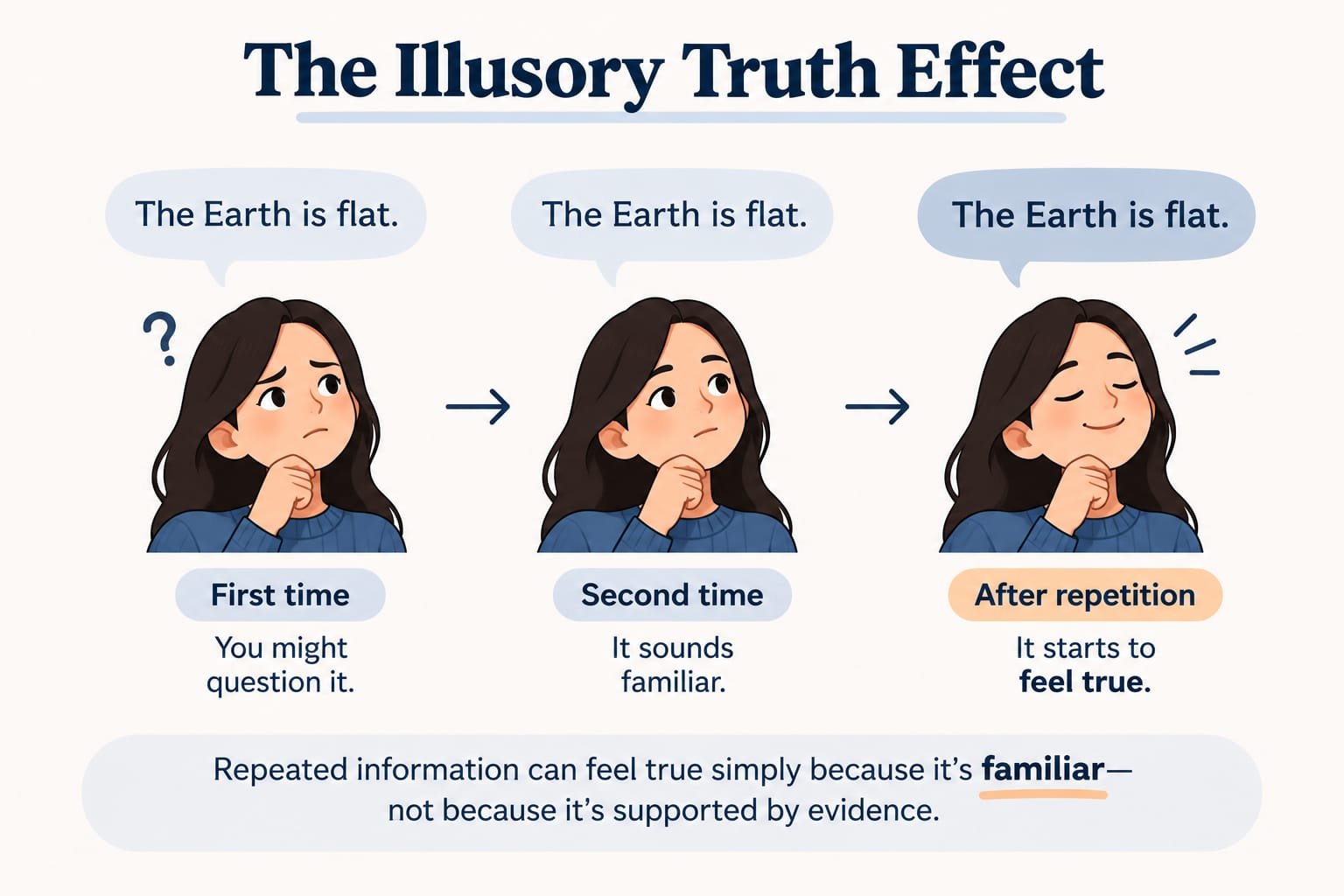
The illusory truth effect is a psychological phenomenon in which repeated statements tend to feel more believable than new statements, even when repetition provides no new evidence that the statement is true.
The phenomenon was formally demonstrated in a 1977 study by Lynn Hasher, David Goldstein, and Thomas Toppino. Participants rated statements they had encountered previously as more likely to be true than statements they had not seen before.
Since then, decades of research have investigated the effect across different types of information.
A 2026 systematic review and meta-analysis examined 182 studies involving more than 31,000 participants and found a small but reliable overall illusory truth effect, while also identifying substantial variation depending on factors such as the material used, exposure conditions, and contextual cues.
So the basic finding is real – but it isn’t as simple as “repeat anything enough times and everyone will believe it.”
Why Does Repetition Make Something Feel True?
One major explanation involves processing fluency.
Processing fluency is the subjective experience of how easily your brain processes information.
Consider two sentences:
” The capital of France is Paris.”
and
“The capital of France is Paris.”
The second sentence is not more factually correct because you have seen it before. But if you’ve already encountered it, your brain may process it more easily.
That ease matters.
Your brain constantly uses mental shortcuts because carefully evaluating every piece of information would be incredibly demanding. Processing fluency can become one of the signals your mind uses when making judgments about information.
Repeated information is often easier to process, and that increased fluency can contribute to higher perceived truth.
The problem is that:
Easy to process ≠ true.
But your brain doesn’t always keep those two things completely separate.
The basic chain looks like this:
Exposure → Familiarity → Easier processing → Greater subjective fluency → Increased sense of truth
That doesn’t mean repetition automatically creates belief. Context, prior knowledge, warnings the source of information, and the way a claim is presented can all influence the effect.
But repetition can quitely tilt the judgment.
It Can Affect People Who Already Know Better
This is one of the more unsettling findings.
You might assume that knowing a subject well should completely protect you from repetition effects.
It doesn’t.
Research has found that repetition can increase perceived truth even when people possess relevant knowledge.
That doesn’t mean knowledge is useless. Quite the opposite: factual knowledge can provide a basis for evaluating a claim.
The point is that knowing something and remembering to use that knowledge during a quick judgment are not the same thing.
Your brain can still experience a familiar statement as fluent.
That’s why the illusory truth effect isn’t best understood as an intelligence problem.
It’s a judgment shortcut problem.
Where Does the Illusory Truth Effect Show Up?
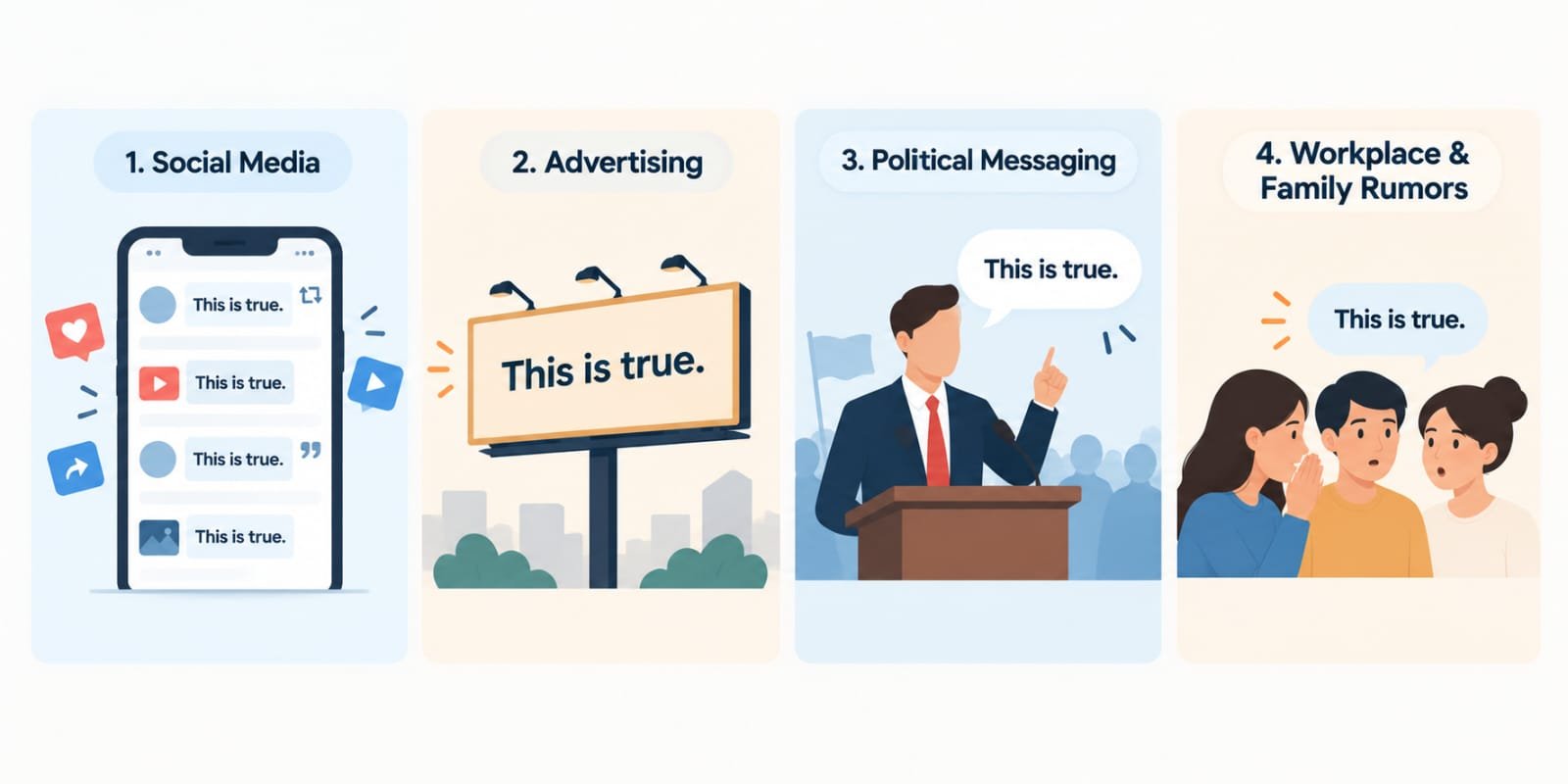
1. Social Media
A misleading claim gets reposted.
Then someone makes a reaction video about it.
Another account quotes it.
A meme uses the same claim.
Eventually, you may recognize the statement without remembering where you originally encountered it.
That familiarity can make it seem more credible.
Research reviews have found that repetition can increase belief in misinformation, including fake-news headlines and conspiracy-related claims.
2. Advertising
Advertisers have long understood the value of repetition.
A slogan heard once may disappear from your memory.
A slogan encountered repeatedly can become instantly recognizable.
Recognition itself isn’t proof that a product is better, safer, or more effective–but familiarity can influence how information feels.
3. Political Messaging
Political communication often involves repeating the same phrases, claims, or talking points.
Repetition doesn’t guarantee persuasion. People bring existing beliefs, identities, knowledge, and skepticism into political judgments.
But repeated exposure can still influence perceived truth, which makes repetition an important part of the misinformation problem.
4. Workplace and Family Rumors
This is where the effect can become surprisingly ordinary.
Someone says:
“I heard that she said…”
Someone else repeats it.
A few days later, another person says:
“Didn’t she say that?”
The original source disappears. The claim remains.
Eventually, the rumor can become something people treat as established fact simply because it has become familiar.
Why Fact-Checking Doesn’t Always Feel as Powerful
There’s an asymmetry between hearing a claim and evaluating a claim. A false statement can be repeated quickly and casually. Checking whether it’s true requires effort.
You have to:
- Identify the original claim.
- Find a reliable source.
- Check the evidence.
- Compare conflicting information.
- Decide which source deserves trust.
Repetition requires almost no cognitive effort. Verification does.
That’s one reason misinformation can spread faster than careful corrections. It also explains why simply seeing a correction once may not completely erase the familiarity created by previous exposure. The solution isn’t to disturb everything. It’s to recognize when familiarity is doing work that evidence should be doing.
How to Protect Yourself From the Illusory Truth Effect
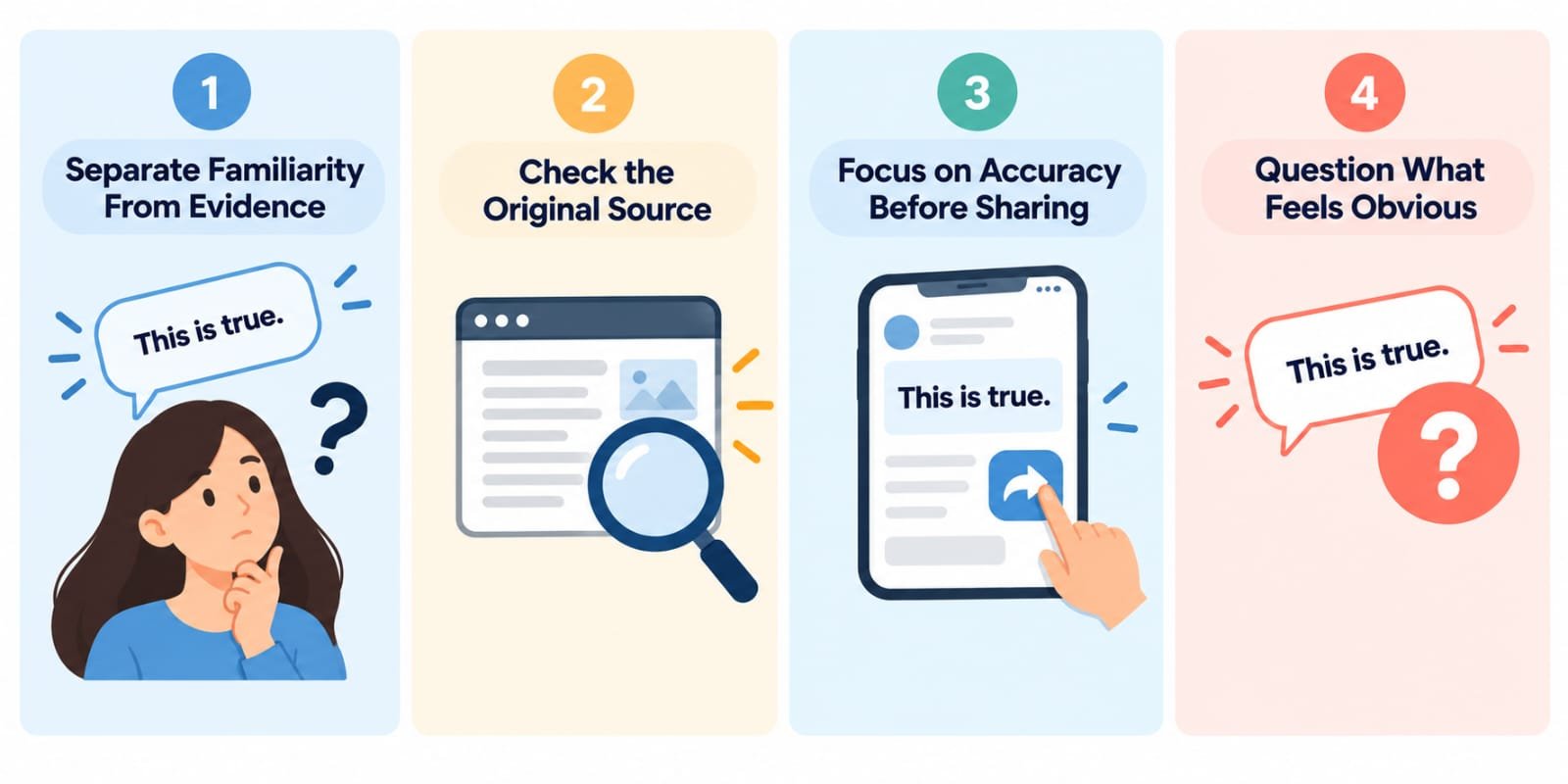
You can’t completely switch off the illusory truth effect, but you can reduce its influence by making your judgments more deliberate.
1. Separate Familiarity From Evidence
When a claim feels true, ask yourself: Do I have a evidence for this, or have I simply seen it many times? Familiarity alone doesn’t establish accuracy.
2. Check the Original Source
Before believing or sharing a surprising claim, trace it back to a reliable source. If you can’t identify where it came from, verify it before accepting it as fact.
3. Focus on Accuracy Before Sharing
Repetition can spread misinformation quickly. Pause before sharing emotionally charged claims, and ask whether the available evidence actually supports them.
4. Question What Feels Obvious
Research suggests that warnings and deliberate attention to accuracy can reduce the illusory truth effect, although they don’t eliminate it entirely. Even a familiar claim deserves scrutiny when its accuracy matters.
What the Research Says
The illusory truth effect has been studied for decades, and research shows that repetition can influence perceived truth—even when a claim is false.
A landmark 1977 study by Hasher, Goldstein, and Toppino found that participants rated repeated statements as more valid than statements they had not encountered repeatedly.
A 2024 review by Udry and Barber found that repetition can increase belief in misinformation, including fake-news headlines and conspiracy claims. The review also identified strategies that can reduce the effect, such as drawing attention to accuracy.
A 2026 meta-analysis covering 182 studies and 31,184 participants found a small overall effect, with considerable variation across studies.
The takeaway? Repetition can influence what people believe, but it doesn’t guarantee belief. Context, prior knowledge, and the way information is processed also matter.
Key Takeaways
- Repetition influences belief: Familiar claims can feel more truthful, even without new evidence.
- Fluency matters: Information that’s easier to process can seem more credible.
- Knowledge isn’t perfect protection: People can still be influenced by repeated misinformation.
- Awareness helps: Checking sources and focusing on accuracy can reduce the effect.
- Familiarity isn’t proof: Verify a claim rather than judging it by how often you’ve encountered it.
Sources & Further Reading
1. Hasher, L., Goldstein, D., & Toppino, T. (1977). “Frequency and the Conference of Referential Validity.” Journal of Verbal Learning and Verbal Behavior, 16(1), 107–112. Read the original study.
2. Fazio, L. K., Brashier, N. M., Payne, B. K., & Marsh, E. J. (2015). “Knowledge Does Not Protect Against Illusory Truth.” Journal of Experimental Psychology: General, 144(5), 993–1002. Read the paper.
3. Udry, J., & Barber, S. J. (2024). “The Illusory Truth Effect: A Review of How Repetition Increases Belief in Misinformation.” Current Opinion in Psychology, 56, 101736. Read the review.
4. Ye, S., et al. (2026). “Systematic Review and Meta-Analysis of the Evidence for an Illusory Truth Effect and Its Determinants.” Nature Communications. Find the publication.
